
Blog
Social Impact Branding: Why Companies Must Lead With Purpose
We are stuck in a brutal trust recession. This isn’t some temporary marketing hurdle your team can out-strategize. Consumers are actively scrolling past claims they don’t buy for a second. Job candidates are turning interviews around and grilling employers about their ethics. Even investors are treating sustainability reports with the same sharp scrutiny they used to reserve exclusively for balance sheets. Across the board, the expectation is loud and clear: if your business doesn’t create real, measurable value beyond the next quarterly earnings call, you are going to lose the room entirely.
This is exactly where social impact branding shifts from a nice-to-have into a survival mechanism. It isn’t a superficial campaign your PR team glues onto your existing corporate identity. It isn’t greenwashing or reputation management wrapped up in progressive buzzwords. It is a core growth strategy built on a simple reality: your company’s survival depends entirely on the value it creates for everyone it touches, not just the people who own your stock.
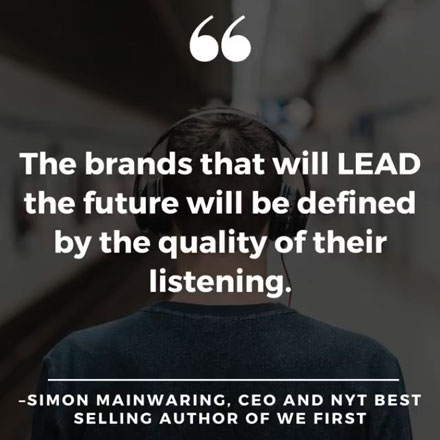
In his book We First, Simon Mainwaring nailed this exact shift. The companies that dominate the coming decades won’t be the ones with the biggest ad budgets. They will be the ones who treat customers, employees, local communities, and the planet as actual partners in creating value, rather than just audiences to be manipulated. That is the engine behind a modern, functional impact marketing strategy. Genuine purpose doesn’t run parallel to your day-to-day business operations; it literally dictates how you run the place.
Why Social Impact Branding Has Become a Business Imperative
For decades, corporate trust was dismissed as a “soft” metric. It was the kind of thing CEOs patted themselves on the back for but rarely brought up when numbers actually mattered in a board meeting. That era is dead. Year after year, data like the Edelman Trust Barometer shows a massive, systemic collapse in public faith toward governments, traditional media, and NGOs. Because of that vacuum, people are looking directly at businesses to step up. They expect the brands they buy from to provide the stability, ethics, and accountability that public institutions have completely failed to deliver.
This shift completely rewrites what a brand actually is. A logo used to be a basic promise of product consistency, you buy this box, you get this quality. Today, that logo is judged as a reflection of corporate character. People want to know how you treat your warehouse staff, where you source your raw materials, and how you behave when things go sideways. Companies didn’t ask for this civic responsibility, but they inherited it anyway. The ones stepping up to the plate are building unshakeable trust, while everyone else is left playing defense and constantly explaining themselves.
Character isn’t proven in a massive press release; it’s revealed in tiny, everyday moments. It’s how your customer service team handles a product defect. It’s your level of transparency after a workplace accident. It’s your choice to speak up or stay silent during moments of cultural tension. Audiences read all of this as evidence of who you actually are. Long after people forget a specific headline, they remember exactly how a brand behaved under pressure. That collective memory is what trust is actually made of, and you build it one tough operational choice at a time, not one campaign at a time.
Read more on Purpose-Driven Leadership.
The Blur Between Purchasing Decisions and Company Values
Stakeholder capitalism didn’t arrive because of an academic paper. It became reality because it turned into a daily shopping habit. Consumers are actively checking where their coffee beans are grown, whether a clothing brand’s factories are independently audited, and whether a tech company’s data handling matches its slick privacy ads. Younger generations, especially, view every single dollar spent as a micro-vote. And they are casting those votes with intention.
This is where social capital turns into a massive, unfair competitive advantage. When a company spends years building real, uncompromised credibility with its community, it doesn’t have to compete purely on price. It wins because of shared alignment. That level of fierce customer loyalty is incredibly expensive to fake and almost impossible for a competitor to copy. That is exactly what makes it so valuable.
It also explains why rushed, reactive purpose campaigns fall flat on their face. Today’s consumers have developed an incredibly sharp radar for the gap between an idealized ad and a messy supply chain. Once that hypocrisy is exposed, good luck closing the gap. Social capital compounds incredibly slowly over years, but it can vanish in a single afternoon. It’s an asset that rewards long-term patience, not short-term speed.
How Purpose Steers Growth, Resilience, and Corporate Reputation
The financial case for integrating purpose has moved far past the creative limits of the marketing department. Businesses that actively live their stated values weather economic downturns with far more customer grace, lock down top-tier talent way faster, and completely avoid the catastrophic reputational trainwrecks that regularly blindside brands with no moral anchor. View your values as an insurance policy for long-term enterprise value, one that pays out exactly when your company needs stability the most.
But none of this works if trust is just treated as a talking point. Cultivating genuine stakeholder trust requires a level of deliberate, measurable, and unyielding consistency across every single interaction your organization has with the public.
How Social Impact Branding Creates Competitive Advantage
Turning Audiences Into Engaged Communities
The old brand-building playbook was simple: grab as much attention as possible, blast your message, and repeat. Social impact branding does something completely different. It builds movements. When consumers feel a personal, emotional connection to your core mission, they stop acting like standard buyers. They become advocates. They recommend you organically, defend you online, and stick with you through price hikes or product blunders that would easily sink a purely transactional business.
The operational difference here is night and day. An audience simply consumes a piece of media. A community carries that message forward on its own back because it feels like the mission belongs to it, too. This is the difference between a vanity follower count and a dedicated baseline of people who will show up for your brand when things get tough. Communities offer forgiveness; audiences just click away to a different feed.
The Shift in Employee Expectations
The modern workforce has fundamentally changed what they are willing to trade their life and time for. Paychecks still matter, obviously, but money alone no longer lands or retains the best talent. People want to know what an organization actually stands for before they sign away years of their career. Purpose-driven companies consistently maintain a massive upper hand in recruiting candidates who might otherwise choose a competitor offering a slightly bigger salary but a completely hollow story.
That recruiting edge keeps paying dividends long after the onboarding process ends. Employees who actually believe in what they are building stay at their jobs longer. They turn into organic brand ambassadors, talking about their workplace in authentic terms that no ad agency could ever script. You cannot manufacture that level of advocacy through an HR initiative; it has to be earned through absolute alignment between what you say and what you actually do inside the building.
The Evolution of Investor Evaluation
ESG investing has grown past its early, check-the-box compliance phase. It has turned into a sophisticated lens for analyzing long-term corporate survival. Data from groups like Just Capital consistently proves that companies prioritizing stakeholder metrics, meaning they treat their workforce, customers, and local communities as core priorities alongside shareholders, frequently deliver much steadier long-term financial returns than competitors focused entirely on short-term quarterly spikes.
Investors are reading these signals loud and clear. Big capital is moving toward organizations that can definitively prove, rather than just claim, that they manage risks across their entire ecosystem. Your social impact narrative is no longer a separate, feel-good deck for the annual meeting. Increasingly, it is your investment story.
This completely changes how companies have to approach corporate disclosures. Impact metrics used to be buried in a corporate social responsibility appendix that nobody outside the compliance team ever read. Today, it is brought up in the same rooms as revenue growth and profit margins. Why? Because institutional investors have learned the hard way that a company careless with its stakeholders eventually becomes a company careless with its capital.
Reputation as a Function of Consistent Action
Authenticity, transparency, and accountability aren’t separate corporate virtues. They are just the natural byproduct of the exact same business habits repeated day after day. A beautiful, high-budget video campaign can generate a quick spike in public goodwill. But a resilient reputation, the kind that can actually survive a brutal public crisis, is forged through years of operational choices that match your outward story. Every consistent decision acts as a deposit in the trust bank. Conversely, any visible gap between your message and your behavior triggers an immediate, massive withdrawal that no marketing budget can fix overnight.
Building an Impact Marketing Strategy That Goes Beyond Campaigns
Purpose Begins From Within
If your strategy originates entirely within a marketing or PR department, it is dead on arrival. Purpose has to start at the governance level. A mission statement written by copywriters but ignored by executive leadership will be called out by your own employees and customers within months. Your governance frameworks, boardroom priorities, and executive incentive structures must directly mirror the values you project to the outside world.
This is exactly why achieving true, uncompromised leadership alignment is the mandatory foundation of a credible strategy, never an afterthought. Corporate culture always flows from the top down. Every public claim your brand makes must be traceable back to decisions made in executive sessions long before a customer ever sees them.
Framing a Credible Narrative
Storytelling only works when it is backed by concrete evidence that a skeptical public can easily verify. Claims without data read as pure advertising; claims backed by independent audits, hard metrics, and transparent outcomes read as genuine commitment. This cohesive strategy narrative must remain entirely seamless across every single corporate channel. Your social media feeds, executive interviews, and formal annual reports all need to tell the same story, ensuring no version of the narrative contradicts another.
Executing this correctly means treating your corporate narrative as a core operational discipline, not a seasonal marketing theme that gets swapped out when the creative calendar turns. It also requires the humility to be completely honest about where your company is still falling short. A narrative that only highlights unblemished victories quickly starts to sound manufactured. Acknowledging ongoing challenges signals a company that is paying attention and actively doing the hard work.
Activating Internal Brand Ambassadors
Before your purpose-driven story can convince a single external customer, it has to win over the people working right inside your building. Your internal corporate culture is the ultimate testing ground for external credibility. When a shared mission genuinely influences how day-to-day decisions are made on the floor, employees carry that conviction outward completely unprompted. They talk about it in casual conversations, share it on social platforms, and highlight it when explaining their work to family and friends. This type of grassroots ownership is worth far more than any scripted marketing campaign.
Intentionally bridging the gap between culture and performance turns internal alignment into a highly visible asset, rather than keeping it isolated as a private human resources project.
Operationalizing Corporate Sustainability
A dedicated sustainability page on your website means absolutely nothing if your underlying supply chain reveals a completely different reality. True purpose must actively influence your procurement choices, product design, logistics partnerships, and the quiet, everyday operational choices that never make it into a flashy press release. That is the dividing line between an enterprise that merely talks about green initiatives and one that genuinely practices sustainability stewardship.
Real operational stewardship means auditing your supply chains with uncompromising honesty, selecting vendors who adhere to the same ethical standards your brand claims for itself, and possessing the corporate courage to report systemic shortfalls alongside your environmental milestones.
Social Impact Branding in Action: Real-World Corporate Lessons
Patagonia has spent decades treating environmental activism as a core business directive rather than a marketing angle, famously donating profits to grassroots conservation and actively telling customers to think twice before buying replacement gear. Ben & Jerry’s has integrated social advocacy so deeply into its corporate DNA that consumers expect the brand to take public stances on complex systemic issues and would likely be confused if the company remained silent.
Bombas engineered its one-for-one giving model straight into its foundational unit economics, ensuring that social impact functions as a structural operational cost rather than a leftover donation sliced out of post-profit margins. Tony’s Chocolonely turned supply chain transparency and slave-free sourcing into its entire brand identity, openly publishing its raw cocoa origins and inviting the exact type of external operational scrutiny most global confectioners actively avoid.
Unilever utilized its Sustainable Living Plan to drive purpose deep into the infrastructure of a massive, multi-brand global conglomerate, proving that immense corporate scale and ethical intent are not mutually exclusive. Meanwhile, Allbirds turned carbon reduction into its primary market differentiator, stamping tangible carbon footprint metrics directly onto its packaging the way food brands list ingredients.
The common thread linking these diverse examples is not clever advertising copy. None of these organizations rely on superficial ad campaigns to sustain its reputation. Instead, their core purpose dictates their supply chains, leadership priorities, internal cultures, product designs, and stakeholder relationships. Because the story is lived operationally, it holds up perfectly under intense public scrutiny instead of fracturing the moment someone looks at the data.
It is also worth looking at how these companies navigate crises. Every single one of them has faced public criticism at some point, whether over premium pricing, internal policies, or controversial partnerships. Yet, they consistently emerge with their corporate reputations intact. This resilience is not a stroke of luck. It is the direct dividend yielded by years of consistent, operational integrity, paying out exactly when the brand needs public goodwill to navigate a storm.
The Future of Social Impact Branding Belongs to Companies That Lead With We
Moving From Shareholder Value to Shared Prosperity
Conscious capitalism has officially transitioned from university lecture halls directly into competitive boardrooms. The enterprises currently breaking away from the pack are those that stopped viewing shareholder value and shared prosperity as zero-sum, competing priorities. Instead, they treat collective well-being as the baseline requirement for financial performance. A business that systematically creates value for its workforce, its consumer base, and its local communities builds an elite level of systemic stability that eventually reflects clearly on the balance sheet over a longer, far more predictable timeline.
The Critical Role of Independent B Corp Certification
B Corp certification has emerged as one of the most reliable ways for a business to prove its purpose-driven claims are validated by strict external standards rather than self-authored marketing materials. The evaluation metrics managed by B Lab force companies to hit verified performance benchmarks across worker treatment, corporate governance, environmental impact, and community equity. This rigorous accountability framework creates a clear line of demarcation between authentic operational purpose and simple corporate whitewashing.
Cultivating Movements Through Thought Leadership
True systemic change cannot scale without visible, articulate leaders willing to champion the cause publicly. Chief executives and corporate leadership teams are increasingly required to step up as public voices for the societal issues their organizations support. This isn’t just about meeting modern public relations expectations; it’s because executive silence is frequently interpreted as a lack of true conviction in a market where everyone is asking harder questions. Authentic thought leadership transforms an internal corporate mission statement into an external narrative that the broader public can genuinely trust and rally behind.
Developing this caliber of public voice is frequently what elevates a company’s story from a forgotten page on its website into a powerful narrative that reshapes an entire industry’s standard practices.
Position Your Brand Before Competitors Move In
Social impact branding is no longer an optional marketing luxury. Treating purpose as a sporadic campaign theme rather than a foundational operating principle is a high-stakes gamble against the clear direction where consumer trust, global talent, and institutional capital are already flowing. The organizations that will secure public trust tomorrow are those investing today in systemic equity, community stability, and verified, measurable impact.
The foundational truth remains completely accurate: businesses grow strongest and prove most resilient when they generate real value for every single entity connected to them. Executed with integrity, this philosophy transforms standard customers into fiercely loyal communities and standard corporations into authentic public movements, offering a far more durable foundation than any single quarter’s financial statement could ever provide.
The companies still treating purpose as an optional cosmetic layer are leaving valuable territory completely unprotected. The real question executive teams must confront isn’t whether social impact matters. It is whether they are truly ready to let that purpose dictate their real-world operational choices, rather than just using it to describe their actions after the fact.
Frequently Asked Questions about Social Impact Branding
What separates social impact branding from traditional corporate social responsibility (CSR)?
CSR typically functions as an isolated program operating alongside the core business, frequently managed as an independent budget line for annual corporate donations or organized employee volunteer days. Social impact branding is fundamentally different: purpose directly informs executive leadership, internal culture, and daily operations rather than sitting on the periphery.
How long does it take to establish a truly credible purpose-driven brand?
There are no shortcuts to authenticity. True credibility is earned through years of repetitive, consistent operational choices, not a fast creative rebrand. Most organizations begin to realize genuine trust dividends only after their stated purpose has guided multiple product development cycles and tough leadership decisions.
Does social impact branding have a measurable effect on financial performance?
Yes. Data shows that purpose-led organizations regularly experience deeper customer retention, lower talent recruitment costs, and significantly steadier investor confidence during economic downturns. This impact rarely presents as a temporary quarterly spike; instead, it manifests as long-term corporate resilience and steady enterprise value.
Is B Corp certification mandatory to be viewed as an authentic purpose-driven brand?
Formal certification is not strictly required, but it provides a level of independent, third-party verification that self-reported corporate claims simply cannot replicate. It serves as a strong signal of institutional validity, though it remains one of several pathways to building real market credibility.